Introduction
Modern software delivery moves fast. Companies want to release new features daily. They want to fix bugs in minutes. But old ways of working slow them down. Development teams and operations teams often work in silos. This separation causes delays, miscommunication, and unstable systems.
To solve these problems, organizations need a cultural and technical shift. They need practices that bring development and operations together. They need automation for infrastructure and security. They also need reliable systems that scale smoothly.
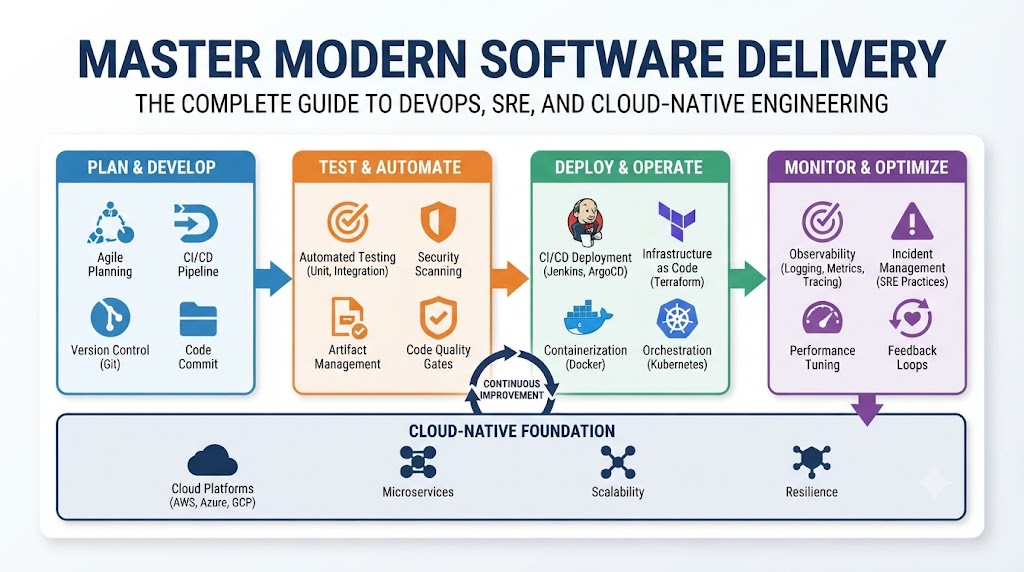
This guide explores the core pillars of modern software engineering. We will look at DevOps, SRE, DevSecOps, MLOps, and infrastructure automation. We will also discuss how structured corporate training and expert guidance help teams succeed.
What is DevOps and Why Does It Matter?
DevOps is not just a tool. It is a culture. It bridges the gap between software developers and IT operations teams. In traditional setups, developers write code and hand it over to operations. Operations teams then try to run it in production. If something breaks, both teams blame each other.
DevOps changes this dynamic. It encourages shared responsibility. Teams work together from the planning stage to production deployment and monitoring.
Core Benefits of DevOps
- Faster software delivery cycles.
- Higher system stability and reliability.
- Quicker recovery from failures.
- Better collaboration across departments.
Implementing these practices requires deep knowledge and hands-on skill. Many organizations choose DevOps 研修 to upskill their engineers. Structured training helps teams learn modern workflows, CI/CD pipelines, and automation tools effectively.
Bridging Skill Gaps with Corporate Training
Adopting new technology is hard. Buying tools is easy, but teaching people how to use them takes time. Japanese enterprises face unique challenges in modernizing legacy systems. Engineering teams need practical, hands-on learning experiences.
Many organizations rely on DevOps corporate training Japan programs to build internal capabilities. These programs focus on real-world scenarios. Teams learn how to build pipelines, automate testing, and manage cloud environments safely.
Structured learning reduces friction during digital transformation. It gives developers and system administrators confidence. When teams learn together, they build a shared language and common goals.
Getting Expert Guidance Through Consulting
Internal teams often face roadblocks. They might not know how to redesign legacy pipelines. They might struggle with cloud migration strategies. Bringing in an outside expert provides a fresh perspective.
DevOps コンサルティング helps organizations evaluate current workflows. Consultants review deployment pipelines, team structures, and tool chains. They identify bottlenecks and security gaps. Then, they create a clear roadmap for improvement.
For businesses operating in local markets, working with a specialized DevOps consultant Japan provider ensures tailored advice. Local consultants understand regional business needs, compliance rules, and enterprise expectations. They help teams adopt automation without disrupting daily operations.
Infrastructure as Code with Terraform
Manual server setup is slow. Clicking through web consoles leads to human error. If a server crashes, rebuilding it by hand takes hours.
Infrastructure as Code solves this problem. It allows engineers to define infrastructure using configuration files.
What is Terraform?
Terraform is a popular open-source tool for building and managing infrastructure. It lets teams write code that describes cloud resources.
- Servers
- Databases
- Networking components
- Security groups
Why Terraform Matters
Terraform tracks infrastructure state. If a change is needed, engineers update the code and apply it. The tool updates only what is necessary.
Teams often join a Terraform 研修 program to master this technology. Hands-on learning covers state management, module creation, and safe deployment strategies. Automated infrastructure reduces downtime and speeds up environment provisioning.
Container Orchestration with Kubernetes
Modern applications run in containers. Containers package code and dependencies together. This ensures the application runs the same way on a laptop as it does in the cloud.
However, managing hundreds of containers is difficult. If a container crashes, something must restart it. If traffic spikes, something must add more containers.
Understanding Kubernetes
Kubernetes is a container orchestration tool. It automates container deployment, scaling, and networking.
- It helps teams manage many containers across different systems.
- It automatically replaces containers that fail.
- It balances network traffic across active containers.
Because Kubernetes has a steep learning curve, organizations invest in Kubernetes 研修. Good training teaches container fundamentals, cluster architecture, and troubleshooting techniques. Engineers learn how to keep production environments stable and scalable.
Ensuring High Availability with SRE
Moving fast is important, but systems must also stay reliable. If a website goes down, the business loses money.
Site Reliability Engineering applies software engineering to IT operations. SRE teams treat operations problems as software problems. They write code to automate manual tasks and prevent system failures.
Key Focus Areas of SRE
- Monitoring system performance.
- Setting service level objectives.
- Automating incident response.
- Conducting root cause analysis.
Building a reliable engineering culture requires specialized education. Teams often take an SRE 研修 course to learn modern reliability practices. They learn how to measure system health and reduce manual toil.
Integrating Security with DevSecOps
Security used to happen at the very end of development. Security teams checked code right before release. If they found a vulnerability, the release was delayed. This caused tension between security and development teams.
DevSecOps shifts security to the left. It means building security checks into every stage of the software delivery lifecycle.
What You Learn in DevSecOps
- Secure coding practices.
- Automated security testing in CI/CD pipelines.
- Vulnerability scanning for dependencies and containers.
- Compliance checks as code.
To adopt these practices, organizations use DevSecOps 研修. Engineers learn how to find security flaws early. They discover how to fix vulnerabilities without slowing down release cycles.
Managing Machine Learning Pipelines with MLOps
Machine learning models differ from traditional software. Writing code is only the first step. Data changes over time. Models degrade. They need continuous monitoring and retraining.
MLOps combines machine learning, data engineering, and DevOps.
Core MLOps Practices
- Automated model training pipelines.
- Model registry and version control.
- Performance monitoring in production.
- Continuous integration for data workflows.
As artificial intelligence adoption grows, teams need specialized skills. An MLOps 研修 program helps data scientists and engineers collaborate. It teaches them how to deploy and maintain machine learning models reliably at scale.
Ensuring Operational Continuity with Technical Support
Even with great automation and skilled teams, issues happen. Production systems can experience unexpected errors. Cloud providers can have outages. Complex pipelines can fail during updates.
When critical issues occur, internal teams need fast answers. Waiting days for help hurts business operations.
Reliable DevOps support Japan services give engineering teams peace of mind. Expert support helps with:
- Troubleshooting complex pipeline failures.
- Resolving infrastructure bottlenecks.
- Guidance on best practices during updates.
- Operational assistance during peak traffic events.
Having access to experienced engineers ensures that technical problems get solved quickly. It minimizes downtime and keeps development moving forward.
Comparison of Modern Engineering Technologies
| Technology / Practice | Primary Purpose | Key Benefit | Ideal For |
|---|---|---|---|
| DevOps | Cultural & workflow alignment | Faster delivery cycles | Entire engineering department |
| Terraform | Infrastructure as Code | Automated provisioning | Cloud and platform engineers |
| Kubernetes | Container orchestration | Scalable container management | Developers and system operators |
| SRE | System reliability & automation | Reduced downtime & toil | Operations and reliability engineers |
| DevSecOps | Integrated security practices | Early vulnerability detection | Security and development teams |
| MLOps | Machine learning lifecycle | Reliable model deployment | Data scientists and ML engineers |
Frequently Asked Questions
What is the main goal of DevOps training?
DevOps training helps teams understand modern software delivery workflows. It teaches collaboration, automation, and continuous integration. Participants learn practical skills to reduce deployment errors and speed up release cycles.
How does Infrastructure as Code help organizations?
Infrastructure as Code allows teams to define servers and networks using configuration files. This eliminates manual setup errors. It also lets teams recreate environments quickly and maintain consistent configurations across staging and production.
Why is Kubernetes important for modern applications?
Kubernetes automates the deployment and scaling of containerized applications. It manages resource allocation across clusters. It also restarts failed containers automatically, ensuring high availability for user traffic.
What does a DevOps consultant do?
A DevOps consultant reviews existing software development and deployment processes. They identify bottlenecks and suggest improvements. They also help teams implement automation tools and adopt reliable engineering practices.
How does SRE differ from traditional IT operations?
Traditional operations rely heavily on manual server management and reactive troubleshooting. SRE applies software engineering principles to operations. It uses automation to prevent failures and focuses heavily on measuring system reliability.
Why is DevSecOps necessary for development teams?
DevSecOps integrates security checks into early development stages. Instead of testing security at the end, teams scan code and dependencies continuously. This catches vulnerabilities early and prevents costly security incidents in production.
What kind of companies need MLOps?
Companies that build and deploy machine learning models in production need MLOps. It helps manage data pipelines, model versions, and continuous monitoring. This ensures machine learning models remain accurate over time.
How can corporate training benefit Japanese enterprises?
Corporate training helps internal teams build shared technical skills. It reduces reliance on external vendors. It also supports digital transformation by giving engineers hands-on experience with modern cloud tools.
When should an organization seek technical support?
Organizations should seek support when facing complex pipeline failures or infrastructure scaling issues. External support provides fast troubleshooting. It helps teams resolve critical incidents without losing valuable development time.
Is prior coding experience required for Terraform training?
Basic understanding of system administration and command-line tools is helpful. While deep software development skills are not required, familiarity with configuration files and basic scripting makes learning Terraform much easier.
Conclusion
Modernizing software delivery requires more than new tools. It requires a shift in culture, processes, and technical skills. From DevOps and SRE to infrastructure automation and MLOps, each practice plays a vital role. Teams that invest in structured learning and expert guidance build stronger systems. They release software faster and handle production issues with confidence. By combining good architecture, automated pipelines, and continuous education, organizations can achieve long-term success in the digital age.